Updated on: November 2, 2026
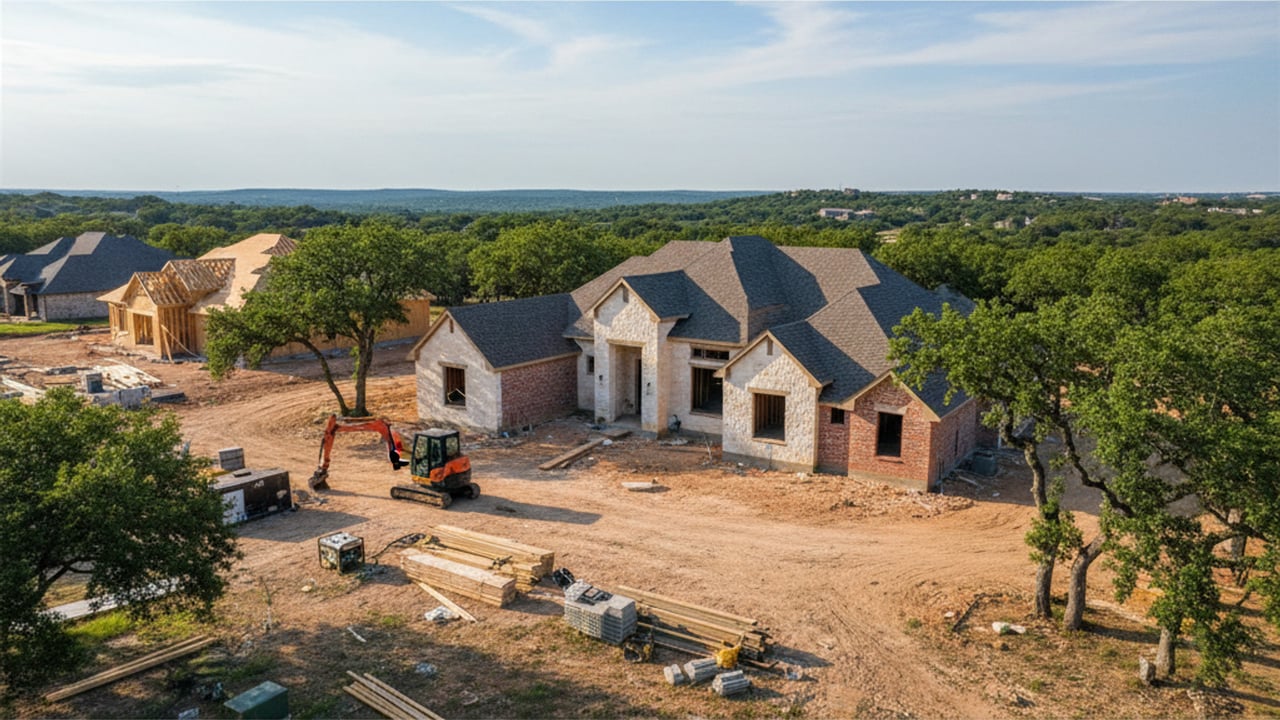
Building on your own land in Boerne means hiring a builder, or acting as your own builder, to put a home on a lot you own or buy. Weigh land, site and permit costs against the current market before you commit.
Key Takeaway
Before you design anything, confirm whether your lot is inside Boerne city limits or in unincorporated Kendall County. That decides who issues your permits, whether city utilities are available, and whether you budget for a well and septic system. Then read the deed restrictions and any HOA builder rules before you pick a builder, because they can limit your materials and your choice of builder.
Who This Guide Is For
Anyone who owns, or plans to buy, a lot in Boerne or Kendall County and wants to build a home on it.
Building on Your Own Land in Boerne at a Glance
- Boerne permits homes inside city limits; unincorporated county has no building code.
- Well-and-septic lots in Kendall County need at least 3 acres.
- Budget $165 to $450+ per square foot, plus well, septic or impact fees.
- City permit review takes about 21 days; county septic review takes 10 to 14 working days.
- Texas needs no general contractor license; owners may do homestead plumbing and some electrical work.
Build on Your Own Lot or Buy in a Boerne Builder Community?
Building on your own lot and buying in one of Boerne's planned communities both get you a new home, but the two paths differ on five points.
- Control: On your own land you choose the site, the home's orientation, the floor plan and the builder. In a community you pick from a builder's plans and its remaining lots.
- Timeline: A lot build adds site evaluation, design and permitting before construction starts. A community home may already be underway or finished.
- Cost certainty: A community home has a base price, and utilities are already at the lot. On your own land, well, septic, driveway and rock costs only become clear after due diligence.
- Financing: A lot build usually needs a construction loan paid out in draws. A finished community home can close with a standard mortgage.
- Resale: A custom home on acreage appeals to a narrower set of buyers than a community home, so check resale prices in Boerne for similar homes before you set your budget.
Builder incentives, lot premiums and plan options change often, so get current terms from the builders in Boerne's new-construction communities and compare them with your all-in own-lot budget.
Checking Your Land Before You Build in Kendall County
Vacant 1 to 3 acre homesites around Boerne were listed at roughly $275,000 to $400,000 in early November 2026, based on active MLS listings. Smaller platted lots run lower (one 0.74-acre lot was listed at $149,500), while gated-community acreage such as Cordillera Ranch can top $700,000 for similar tracts. Lots of 5 acres or more ranged from about $385,000 for a 6-acre lot to $995,000 and up for larger gated tracts. Price moves with:
- acreage, road frontage and access
- slope and rock
- utility availability
- river or view frontage
- whether the lot sits inside city limits
Before you close on a lot, or while it is under contract, work through this list:
- City limits or county: Check the City of Boerne's 2024 ETJ maps on its Maps page.
- Inside city limits, the city supplies electric, gas, water and wastewater service from its own utility systems. City zoning also applies there, so confirm the lot's zoning and setbacks with the city before you design.
- In the extraterritorial jurisdiction (ETJ), the city cannot impose zoning. Under its interlocal agreement with Kendall County, amended January 2024, plat review for most ETJ lots goes through the county.
- Utilities outside the city: City utility service generally stops at the city limits, so county lots typically rely on a private well and an outside electric provider. Ask that provider what it charges to bring service to your building site.
- Well and septic lot size: Kendall County's development rules require at least 3 acres and 250 feet of road frontage for a home on a well and septic system. The minimum is 1 acre when the lot has public water and septic. Order a soil and site evaluation before closing so you know which septic system the lot can take.
- Restrictions and easements: The survey and title commitment show recorded deed restrictions and easements. Look for building setbacks, minimum home size and bans on certain structures.
- Flood risk: Look up the lot on FEMA's Flood Map Service Center before buying.
- Legal access: Confirm deeded road access, especially on landlocked ranch parcels.
A geological survey before purchase, especially on larger or ridge-top parcels, shows how much limestone excavation the build will need.
What It Costs to Build on Your Lot in Boerne
Per-square-foot build prices cover the house only. Land, site work and utilities are separate lines in your budget.
Construction: Industry estimates vary:
- A Boerne-focused development planning estimate, dated around October 2026, puts single-family construction at $165 to $305 per square foot, with luxury and custom builds at about $235 to $305.
- A 2026 Hill Country custom-build comparison estimates $250 to $450 or more per conditioned square foot before land and financing. Quality custom construction in premium gated communities such as Cordillera Ranch often starts at $400 or more.
Finishes, roof pitch and plan complexity move the number, and communities with masonry or design mandates push costs higher.
- Site work: Clearing, the driveway, grading and rock excavation on Hill Country terrain, plus engineered foundations on limestone, all add to the budget. Get these priced after the site evaluation, not from a generic estimate.
- Septic: A 2026 Kendall County septic guide puts a conventional system at $9,000 to $16,000 installed. An aerobic treatment unit, required on much of the area's shallow limestone, runs $15,000 to $25,000 or more. Rock excavation adds $2,000 to $4,000 in many cases.
- Well: A complete drilled and equipped well in Kendall County and nearby Hill Country counties typically costs about $12,000 to $25,000 or more because of karst geology. Drilling alone runs roughly $25 to $65 per foot statewide.
- City water and wastewater:
- Boerne's maximum combined water and wastewater impact fee is $7,629 per living unit equivalent, approved by City Council in May 2023. A standard 0.625-inch meter counts as one unit.
- City utility deposits also apply. For a home under 2,000 square feet they are $240 for electric and $120 for water, rising with square footage above that.
- Design, engineering and permits: Ask the City of Boerne or Kendall County for its current fee schedule when you apply.
Most lot builds use a construction-to-permanent loan. It pays the builder in draws during construction and converts to a regular mortgage when the home is finished. If you already own the lot, ask each lender whether your equity in the land counts toward the down payment and how much cash it still requires.
Your best return on investment comes from spending first on the foundation, insulation and HVAC, since finishes are easy to upgrade later.
The Step-by-Step Custom Home Building Process
A regional Hill Country general contractor cites these timelines:
- two to four months for site assessment, design and planning
- four to 12 weeks for permitting where required
- six to 12 months of construction, depending on size and complexity
Weather and material availability can stretch the build.
- Site evaluation: Before you finalize any blueprints, have engineers determine the exact placement of your well and septic systems. Failing to map out these utilities early can force expensive redesigns of your driveway and foundation footprint later on.
- Design: Work with an architect or professional home designer on plans fitted to the lot. Have your builder price them before you finalize them.
- Approvals and permits: Get community architectural approval first where it applies, then the city or county permits.
- Construction: The builder moves from foundation to framing, trades and finishes, with lender and city inspections along the way.
- Move-in: The builder's written warranty takes over.
Building Permits and Contractor Rules in Boerne and Kendall County
Inside Boerne city limits:
- The City's Permitting and Code Compliance Department issues residential permits and inspects all construction.
- The same department handles contractor registration. A contractor must be registered with the city before it can submit a permit application or work in city limits.
- The city's published review schedule targets about 21 days for the first review of a new house and about 14 days for each resubmittal. Those are review targets, not a promise that your permit is issued in 21 days.
In unincorporated Kendall County, the county has not adopted building codes for single-family homes. There is no general residential building permit or inspection, but other permits still apply:
- Development, addressing and floodplain: The Kendall County Engineer's Office handles 911 addressing, subdivision rules, floodplain management and development permits.
- Septic: The Kendall County Environmental Health Department issues all on-site sewage facility (OSSF) permits in unincorporated areas as an authorized agent of TCEQ. A 2026 septic guide gives these review times:
- 10 to 14 working days for a complete application
- 14 to 18 working days from March through June
- four to 10 weeks for the full process, from site evaluation to operating license
- Well: New wells fall under the Cow Creek Groundwater Conservation District. A household well must be registered as a Tier 1 statutory exempt well before drilling. Larger production wells need a permit, and drilling without registering carries penalties.
An incomplete site plan or septic application triggers another review cycle before construction can start. Get submittal checklists from the city or county permit office before your builder or designer submits.
Can You Be Your Own Builder in Texas?
Texas does not license residential general contractors or homebuilders, and the Texas Residential Construction Commission, which once oversaw builders, was abolished in 2010. Any property owner can act as their own general contractor and pull permits as the owner-builder without a contractor license. Specialty trades are different: electricians you hire need their own state licenses.
Several rules still apply to you:
- Permits in Boerne: City registration treats homestead properties differently from other properties. Ask the Permitting and Code Compliance Department what it requires before you apply as an owner-builder.
- Trade work:
- Texas Occupations Code §1301.051 lets you do plumbing on your own homestead without a plumber's license.
- Section 1305.003(a)(6) exempts electrical work by an owner who lives in the dwelling, but only work a city ordinance does not specifically regulate.
- These exemptions cover licensing only. Boerne has adopted the 2020 National Electrical Code and the International Plumbing Code, generally still requires trade permits and inspections, and needs 24 hours' notice for each inspection.
- Lending: Ask construction lenders early whether they finance owner-builder projects and what experience or documents they want.
- Insurance: Ask your insurance agent about builder's risk and liability coverage before work starts.
Bringing Your Own Builder to a Boerne Subdivision
Whether you can use your own builder depends on what is recorded against the lot. Boerne-area lots generally fall into three setups:
- Deed-restricted acreage: Restrictions may set home size, setbacks or materials but do not limit who builds.
- Outside builders after review: At Cordillera Ranch, the property owners association must approve any custom builder. The builder submits a company resume, proof of insurance, a list of prior homes, and business and financial references. Builders on its Preferred Builder roster are already approved, and others can apply.
- Developer builder roster: Esperanza is built out by production builders the developer selected, currently Chesmar, Drees, Highland, Perry, Scott Felder and Toll Brothers.
Where a community reviews plans, the usual order is:
- plan submittal
- builder approval, where required
- architectural approval
- permit application
Esperanza's Architectural Control Committee must approve all construction plans, including on vacant lots. Ask each community for its current review time and build it into your schedule.
Design guidelines commonly require a minimum share of masonry on exterior facades and prohibit metal barndominiums. Native vegetation preservation rules can also dictate which trees you can clear for your driveway. Read the builder rules and property owner association fees before you buy a lot, because an approved-list rule can rule out the builder you want.
How to Choose a Build-On-Your-Lot Builder in Boerne
If your community keeps a preferred-builder roster, start your shortlist there. For a lot inside city limits, confirm each builder is registered with the City of Boerne. Then use criteria you can check:
- Lot experience: Ask how many homes they have built on sloped, rocky Hill Country lots and on well-and-septic sites. A builder who works mainly in flat suburban subdivisions may struggle with the grading and limestone excavation these lots require.
- References: Call past clients and visit finished homes.
- Contract type: A fixed-price contract sets the price up front, while cost-plus passes actual costs through with a fee. Many finish selections happen during construction, so ask how finish allowances work. If your cabinets or flooring cost more than the allowance, you pay the difference.
- Draw schedule: Payments should follow your lender's inspections of completed work.
- Insurance: Get proof of liability insurance and workers' compensation.
- Warranty: Get written warranty terms and the process for filing claims after you move in.
- Site supervision: Ask who runs the site day to day and how that person checks quality at each stage before a draw is requested.
- Lien releases: Texas Property Code Chapter 53 governs mechanic's liens. A lien waiver is enforceable only if it substantially follows one of four statutory forms: conditional or unconditional, on progress or final payment. Collect releases from subcontractors and suppliers with each draw. Without them, a subcontractor or supplier the builder did not pay may claim a lien against your home even after you paid the builder.
A Weigand agent can help you find a lot that suits the home you want to build and run the land checks above before you close. Your agent can also coordinate with builders so the plans, restrictions and budget line up before you commit.
Frequently Asked Questions
Is It Cheaper to Build on Land I Own than to Buy an Existing Boerne Home?
Owning the lot removes the land cost, but build costs plus well, septic, site work and impact fees often bring the total to or above a comparable resale home. In return you get new systems and a builder warranty, so you should face fewer major repairs in the first years than you would in an older home.
Can I Build a Casita or Guest House on My Lot Along with the Main Home?
It depends on your lot's deed restrictions or HOA rules and on whether the city or the county permits it. If the lot is on septic, ask whether the system must be designed to serve the second unit, and confirm that renting is allowed before you plan on rental income. Expect a casita to cost more per square foot than the main home, because even a small unit needs its own kitchen, bathroom, plumbing and utility connections.
Can I Build a Barndominium or Metal-Frame Home on My Boerne Land?
Many Boerne-area HOAs and deed restrictions ban or limit metal exteriors and post-frame homes, but on unrestricted county acreage the choice is usually open. Post-frame construction follows the same permit path as traditional framing. Lenders and insurers may treat post-frame homes differently, so ask both before choosing a design.
Do the Same Rules Apply to a Lot Near Comfort or Elsewhere in Kendall County?
Comfort is unincorporated, so it follows the same county septic, well and development permits and the 3-acre minimum for well-and-septic homes. Deed restrictions vary lot by lot, so read them for each parcel.
Sources
- HAR: Lots and Land for Sale in Boerne
- City of Boerne: Maps
- City of Boerne: Utility Rules and Regulations
- Kendall County Development Regulations, Amendment 8/31/23
- BuildoraIQ: Boerne, TX Land Development Planning
- Texas Septic Guide: Kendall County Septic Regulations
- Well Drilling Costs: Texas Well Drilling Cost Guide
- Citizen Portal: Boerne's 2023 Impact Fee Update
- CMW Texas: Building a House on Your Own Land in Texas
- City of Boerne: Permitting and Code Compliance
- City of Boerne: Permits
- Kendall County: Permitting, Building, Occupancy and Zoning Regulations
- Cow Creek Groundwater Conservation District: Forms
- Build Your House: Texas Permitting Guide
- Texas Occupations Code Chapter 1305
- Cordillera Ranch: The Design and Build Process
- Esperanza: Home Builders in Boerne, TX
- Texas Property Code Chapter 53