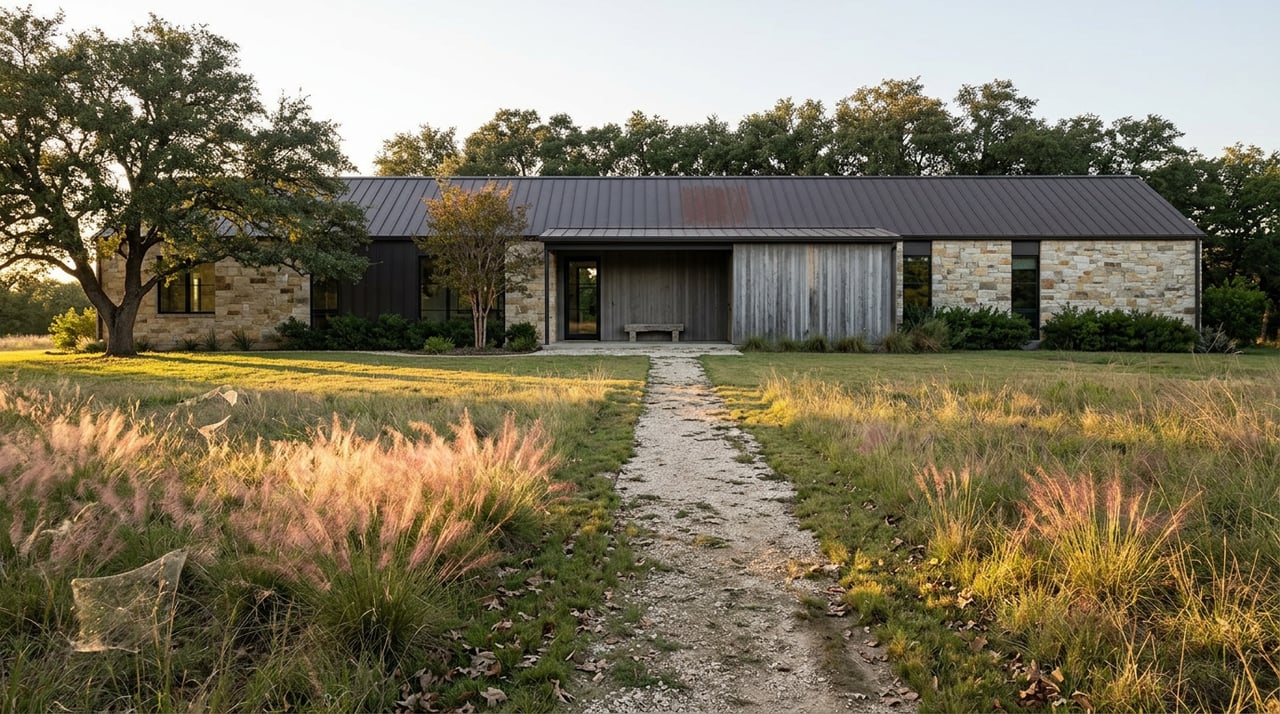
Every acreage listing near Boerne carries two prices. The first is the one on the sign: $6,000 an acre, $9,000 an acre, maybe $12,000 if the tract has road frontage and cleared pasture. The second price never appears in the listing, and it is usually larger than the first. It is the cost of turning raw land into a buildable homesite, and it is the number that actually decides whether that acreage beats an in-town home on a dollar-for-dollar basis.
Buyers comparing a $675,000 home inside Boerne's city limits to a 12-acre tract priced at $9,000 an acre tend to run the math on the sticker price alone. That comparison is incomplete before it starts, and the gap between what raw land costs and what it costs to live on is where a lot of Hill Country buyers get surprised well after they have already waived their option period.
What the Per-Acre Price Leaves Out
Unimproved acreage without utilities or platted access in the Boerne area typically lists in the $4,500 to $12,000 per acre range. That is the number that makes a 10-acre tract look like a bargain next to a quarter-acre in-town lot. What it does not include is everything required to make that land livable.
Drilling a well runs $15,000 to $35,000 depending on depth. If the soil percolation test fails, and on a meaningful share of Hill Country tracts it does, an engineered septic system adds another $25,000 to $45,000. Extending electric service even a modest quarter mile from the nearest line can run $15,000 to $75,000. Add a boundary survey at $2,500 to $5,000, a percolation test at $800 to $1,500, and an attorney review of easements and mineral rights at $1,500 to $3,500, and the soft-cost stack before construction even starts looks like this:
| Cost item | Typical range |
|---|---|
| Water well | $15,000 – $35,000 |
| Engineered septic (if perc test fails) | $25,000 – $45,000 |
| Electric line extension (per quarter mile) | $15,000 – $75,000 |
| Boundary survey | $2,500 – $5,000 |
| Percolation test | $800 – $1,500 |
| Attorney review of easements and title | $1,500 – $3,500 |
Stack those line items together and it is easy to add $50,000 to $150,000 to a raw land purchase before a single wall goes up. That is the second invoice, and it lands on tracts that were marketed on the strength of looking cheap per acre.
The Line That Decides Whether the Tax Break Is Real
There is a second mechanism working underneath the per-acre price, and it is the reason acreage near Boerne so often clusters at specific sizes. Texas allows an agricultural valuation on land used for qualifying purposes like grazing, hay production, or beekeeping, but the standard threshold requires 10 or more acres with documented qualifying use. Wildlife management valuation, which lets an owner maintain the same reduced tax basis while managing habitat instead of livestock, requires 15 or more acres with an approved management plan.
Those two numbers, 10 and 15, are not incidental. They show up constantly in current listings around Boerne. A wildlife-exempt hilltop tract advertised at 11.024 acres. A wildlife-exempt lot at Sendero Ridge inside Cordillera Ranch listed at 14.15 acres, described as one of the last original lots of that size with the exemption still attached. A 20-acre tract marketed explicitly as an "ag-exempted homesite ranch." Each of these sits just above a threshold that determines whether the owner's tax bill reflects the land's market value or its productivity value, and the gap between those two numbers is often the difference between an affordable holding cost and a painful one.
Why the Tracts Line Up Right Above the Threshold
This is the part that tells you something about how the market actually works, not just what it costs. If ag and wildlife exemptions kicked in at random acreage sizes, listings would be scattered evenly across every tract size from five acres to five hundred. They are not. They bunch at 10, at 11, at 14 and 15, at 20. That clustering is a market responding to an incentive, not a coincidence of how land happens to get subdivided.
A seller platting a 40-acre ranch into smaller parcels has a real reason to cut those parcels at 10.5 acres instead of 8, or at 15.2 instead of 12. A parcel that clears the exemption threshold can be marketed with a specific, quantifiable tax benefit attached. A parcel that falls short cannot, even if the land itself is identical in every other way. The acreage number on the listing is doing double duty: it describes the size of the property, and it silently confirms whether the buyer will actually get the tax treatment the listing implies.
The problem for buyers is that the exemption does not transfer automatically just because the previous owner had it. A new owner has to apply, and the qualifying use has to continue. A 10.5-acre tract that cleared the threshold under the seller's cattle-grazing lease does not stay ag-exempt on its own once the cattle are gone and the new owner has not set up a comparable qualifying use.
Zoning Can Undo the Math Before the Well Gets Drilled
Boerne's development code sorts parcels into categories including Agricultural, Rural Estate, and various residential designations, each carrying its own setbacks and impervious cover limits. Agricultural zoning does not automatically permit any agricultural activity a buyer might want. Minimum acreage thresholds and intensity requirements still apply, and some subdivision covenants prohibit agricultural use outright regardless of what the county appraisal district would otherwise allow. A buyer who wants a guest house, a workshop, or any structure beyond the primary home may need a Special Use Permit, a process that requires public notification and a Planning and Zoning Commission hearing, typically taking two to three months at minimum with no guarantee of approval.
None of this shows up in the per-acre price either. It shows up in the option period, when a buyer who assumed the ag exemption and the guest house were both a given finds out that one or both require paperwork the seller never had to file.
Running the Actual Comparison
In-town Boerne listings were pricing around $236 per square foot as of September 2026, with a median list price near $674,000. A buyer looking at that number next to a 12-acre tract at $9,000 an acre, or $108,000 total, sees an enormous gap. Run the second invoice through it and the gap narrows fast. Add the midpoint of that $50,000 to $150,000 infrastructure range and the $108,000 tract is closer to $210,000 before a single square foot of house exists on it. It may still be the right decision, especially for a buyer who wants privacy, acreage, and room for animals that no in-town lot can offer. But it stops being a straightforward discount and becomes a different kind of purchase entirely, one where the land cost and the finishing cost have to be underwritten together from the first offer, not treated as a phase-two problem after closing.
That is the actual thesis worth carrying into a showing on Hill Country acreage. The per-acre number tells you almost nothing on its own. It only becomes useful once you know how many acres clear the exemption threshold, what the perc test says, and how far the nearest utility line actually runs.
A Short FAQ
Does the agricultural exemption transfer to me when I buy land that already has it? No. A new owner has to apply with the county appraisal district, and the qualifying use has to continue under the new owner. An exemption the seller held does not carry over automatically.
What if my tract is 9 acres instead of 10? It generally will not qualify for standard agricultural valuation on its own unless it is part of a larger, contiguous agricultural operation. Confirm the exact requirements with the county appraisal district before assuming a smaller tract qualifies.
Can I still build if the percolation test fails? Yes, but you will need an engineered septic system rather than a standard one, which typically adds $25,000 to $45,000 to the project.
Do deed restrictions ever block an exemption even when the acreage qualifies? Yes. Some subdivisions include covenants that prohibit agricultural activity entirely, regardless of what the appraisal district would otherwise allow. Check the deed restrictions before counting on the exemption.
Acreage near Boerne can be a genuinely smart purchase. It is rarely a simple one. If you are weighing a tract against an in-town home and want the real numbers run side by side before you write an offer, Alexis Weigand Real Estate can walk through the acreage, the exemption thresholds, and the build-out costs together. Schedule a consultation before the option period starts the clock.
